Showing posts with label children's art. Show all posts

Monday, October 14, 2013

Circles, Ovals , Ellipses... OH MY!

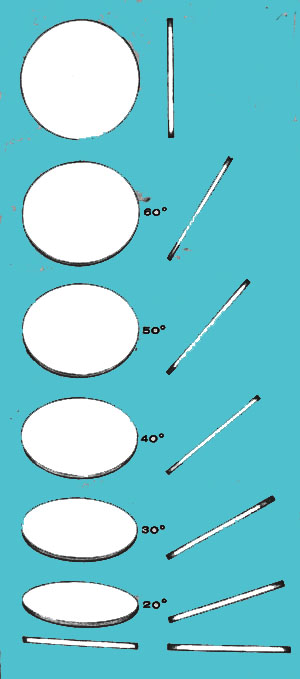
Hi Art Students! As we continue our adventure in drawing,  we now have the components to start creating form. Light and line are both needed, in order to create form. Drawing circles, ovals and ellipses are an important skill to have and can be one of the harder shapes to master, especially in
3-D form. Remember practice makes perfect.

Try this! Take a quarter hold it  so that you see the face of Washington. Now start to slowly tip the top of the coin away from you  a little and stop. Look at the shape of the surface of the coin, has it changed? Now, tip it away some more. Try and make it the shape of the coin in each of the pictures at the left Eventually, the coin will be flat like at the bottom of the picture.

 To translate this concept to your drawing, think about how the angle at which you look at something circular can change, especially the opening of that object. How cool is that? I hope that you will practice some circles, ovals and ellipses this week!


Watch this quick video on how to draw circles and ellipses 


Now if you are excited about your new skills here is another video a bit longer on how to draw a pumpkin just in time for harvest season too!
Bring in your pumpkin picture this week to earn a bonus card- SWEET!!

Saturday, June 8, 2013

2013 A Great ART Year!


Student Artwork HIS Co-op End of the Year Program

This year was wonderful for me as a teacher! I added another art class to my schedule and was so pleased with all the students progress. I taught at two different co-ops, HIS Ministry Co-op and Immanuel Co-op, different style co-ops but both classes engaged great homeschooling students.

This year we studied the world of Modern Art. I have to say, that as a teacher, I was pleasantly surprised by how much my students enjoyed this era of art. What I enjoyed most was being able to present living artists to my students, even one from our area who grew up in my hometown. Students had the opportunity to attend a couple of free exhibits at our local art museum, Andy Warhol and Eric Carle too. I love being able to offer students this opportunity. Experiencing art up close and personal is so different then seeing it on a page in a book.

Students also had the opportunity to enter their artwork into our local Spring Fair and be judged against their peers.  This too, is part of an artists life. I enjoy encouraging my students to take the opportunity to engage other people in what they are doing and to have the courage to take that risk. I never tire of seeing a students confidence increased!

I also enjoyed taking techniques, that I learned in my continuing education over the summer, and teaching them to my students. This year students learned a saturated paper watercolor technique and stenciling technique I learned at a Kay Barnes workshop. Students had fun creating their own stencil to use in their creation of a Marc Chagall  painting.

Below are photos from the End of the Year program at HIS Co-op. Students at HIS Co-op had a great time working collaboratively like, Dale Chihuly, to make a mural. This is our version of  his Mille Flori.  In this project students studied pattern and shape and looked at contrast of colors. Fabulous!

Thanks for a wonderful year and making the world a beautiful place with what you have created, Mrs. W


HIS Mille Flori a Tribute to Dale Chihuly


Student works. Some of the Artists studied: Mondrian, Rene Magritte, Marc Chagall, Jasper Johns, and  Seurat 

Monday, April 22, 2013

Tacoma, Glass, Chihuly...Oh MY!

Dale Chihuly is our next Artist and model for Apprentice with the Masters Art Class.  How exciting to study and learn about a living artist from our own area! Dale Chihuly is an international glass sculptor who has traveled the world and exhibited in many incredible environments.  If you have ever seen an exhibit you know what I mean when I say his artwork takes your imagination to new places! We do not have the budget or the tools to blow glass, but we are going to use the same creative process he does when he is thinking through his work. You and your family can always visit The Museum of Glass in Tacoma to see his work or the Tacoma Art Museum has a gallery of his work as well. But if you can't get there, then you can take a virtual visit here and see the hot shop in action at the Tacoma Glass Museum. Here is an  online look at what is going on in the hot shop today!

We will  watch a video in class so no information video links on this post but I do want you to think through the questions below and come to class ready to share your answers. I think you will be fascinated by the beauty of his art  and his ingenious!

Here is a look at just a few of his pieces to inspire your own imagination.


Two things to think about :
1. How does he blow so many pieces of glass to make his sculptures?
2. What does his glass sculptures remind you of?
3. Do you see any elements of art in his work? Which ones?(hint: look at your new vocabulary words)


Monday, March 18, 2013

The Art of Eric Carle


I am really excited to introduce our next model of study. He is a living, modern, artists. Not only is he an artist but also a designer, an author and illustrator too! I am talking about the gentleman who wrote, The Very Hungry Caterpillar, Eric Carle.

He has an exhibit at the Tacoma Art Museum that I hope you will take the time to see this April. I think it is very special to study an artists work and then go get to see it in real life!  Go HERE if you don't know the story of The Very Hungry Caterpillar and listen to the artist read this story to you. Go HERE to see how the artist paints the paper he uses to make his art and then, go HERE to see how he then makes pictures with the paper he has created. Talk about SUPER cool!

Eric Carle reading his book

We will be using this process to make art of our own so please be thinking about what in nature you would like to create a picture of. What colors you will want to use?  Choose 4 colors for your picture. Remember our color theory class time? Will you use Primary, Secondary or Tertiary colors? Will you use a warm palette or a cool one? How will you texture your paper? This is a requirement for your picture, please think about this when doing your preliminary design work in class.

Sunday, February 24, 2013

Looking at the Flag


Flag, 1954-55


Jasper Johns

Art students what is so special about this flag? Is it that it represents our country? It is a symbol of freedom and democracy?  Please look at these 2 You tube videos #1 HERE and #2 HERE to learn about our next Modern Art model Jasper Johns. He is considered a Pop artist. What makes him a pop artist? What medium does he use to paint with? Come to class and be able to talk about why he paints flags.


                               Colored Alphabet                                                                                              Figure 8 

Tuesday, January 22, 2013

Seeing Eye to Eye

The False Mirror, 1928, Oil


The Return 1940, Oil
Our next model for art class is Rene Margritte. Another Surrealist and very imaginative painter. Please visit this Youtube video for an informative short video all about him for class.(the music may be distracting, it was for me for some reason, so just mute) I think you will really like it. He is very good at using positive and negative space which is our next element of art to explore in class.

Wednesday, December 26, 2012

Chagall

Couple and Fish

Our next model is an interesting fellow and one I like very much. The more I learn about his life the more I like his artwork. His name is Marc Chagall. Here are a couple of informative You Tube Videos to give you some additional information about his life.


Marc Chagall

Can you tell me some of the different medium that he worked in? Can you tell me about his religious beliefs from his artwork? What kinds of symbols do you see that would tell you about who he is and where he comes from? You may have to look closely but I bet you will be able to tell.
Video 1
Video 2

Look at how large these paintings are-just beautiful!


Autumn in the Village


Tree of Life 1948

The Blue Circus

Sunday, October 28, 2012

Seurat- Color and Pointillism

Eiffel Tower 1889
As we move into our next Art Element of study Color, I am excited for my students to study and interesting artist Seurat. He developed a painting technique called Pointillism. Using dots of colors to fool the eye into thinking it is a mixture of another color. It still exists today in how comics are colored, and anything that has  pixelated color, computers, cell phones, etc. these things build on this artistic way of mixing color.
Georges Seurat
For example: dots of blue and red together trick the eye into thinking it is purple if you are far away from it.  Here is what I mean, look at the picture below I took at the Metropolitan Museum of Art in New York. This is Sunday Afternoon on the Island of La Grande Jatte, the bottom picture is a close up of the lower right hand corner of the painting.


Sunday Afternoon on the Island of La Grande Jatte

detail of Sunday Afternoon on the Island of La Grande Jatte
As you can see from far away your eye is tricked into thinking it is another color when really it is several hues used to make one. Interesting, don't you think?
Please link to the following YouTube to see a 3 min. video all about Seurat and his artwork.  Then go to this video to see a time laps self-portrait done in pointillism- this is super cool!

Monday, October 1, 2012

Edvard Munch


Munch is famous for his painting The Scream. But he was also a great expressionistic painter and painted many other moving paintings. I wanted students to be able to see an artist's work as a whole. Munch created so many works depicting the deep emotional places of life, many of them filled with extremes, such as great love and great loss. This is a great view of the culmination of his life’s work, call The Frieze of Life.

At the website below students will still get a great understanding for this artist, even if they view just a few slides in each section. (warning there is nudity: slides #7, 11, 13, 18, 22) The  wonderful thing about this site is that the notes for each painting are a primary source! Munch’s own words, from his own diaries. I hope you will take time to visit and explore the world according to Munch.


This is our artist model as we study the element of light. So much of Munch's work is from a deep place of emotion,  I chose this painting because it offered a bright look at life and the environment around him at the time he painted this picture. Students will be using oil pastels and watercolor washes to paint this picture.

Study of Light, Value and Shading

 Watch the following fun videos on shading. I hope they will inspire you to get out your art box and practice what we have been learning in class! Try different techniques and different mediums. Pens and cross-hatching, Charcoal and smooth blending with your smudge nubs, Sketch pencil and lines. Get creative! What did you like best? What did you find difficult?

Shading shapes into forms- this is awesome!  I hope it will inspire you to practice your shading! This complements what we learned about in class today.                       http://youtu.be/ExRRHY9wT6Q


This is a fun video to watch on how to draw a pumpkin and shade it . Can you see the value scale on the pumpkin?Which direction is the light coming from?

                              Shading a pumpkin http://youtu.be/xJnMK-kSbEo


Thursday, August 23, 2012

The Study of Line

Please watch to see this artists work and how it changed over time from representation to abstract. Please be prepared to answer the following questions in class. Do you recognize this artists work? Do you notice anything about the lines this artist uses? Do they change over time? How? Do you like his early work or later work better?

Thursday, May 17, 2012

A Year in Art


Concentric Circles- Study of Color-11yrs. Old
Paints, smocks, techniques, vocabulary words, museum cards, art paddles, portfolios...my goodness! I am so proud of my art class this year( well I say that every year) but I am feeling a sense of accomplishment and gratitude towards my class.I suppose this is just typical musings of a teacher at the end of another school year, but true none the less. I was inspired by this years class and their attitude and encouragement of one another. They were kind, respectful and supportive of each other and so eager to learn.  Their excitement to learn and try new mediums was infectious too.
     It really made class time fun and relaxing at the end of our co-op day.

Personal Piece-Mixed Media-8yr. old

This year we studied American and European artist and artwork ranging mostly from 1830-1920, along with that, students learned all the Elements of  Art and Principles of Design. We had a great time playing games that solidified our vocab words, techniques, artwork and artists.
Personal Piece- Color Pens-10 yrs. old
Personal Piece- Mixed Media-13 yrs. old

Winter's Stormy Seas- Watercolor-11 yr. old


The artist we covered this year: Gustav Klimt, Vassily Kandinsky, Thomas Cole, Vermeer, Monet, Van Gogh, Frederick Remington, Joseph Turner, along with Navajo Blankets and NW Totem Poles. Students made a personal choice piece as well
and we did two collaborative projects, one in which we sold raffle tickets and donated the money to a family in need at our co-op.Here is some of my classes artwork.


Blue Pear- Study of Monochromatic colors - Acrylics-14 yr. old

Personal Piece- Colored Pencils-8 yrs. old


Marnau St.- Acrylic Paints- 11 yrs. old


Another Catskills Creek-Oil Pastes and Watercolors- 11 yrs. old

Birch Trees-Study of line- Mixed Media-14 yrs old. 


Personal Piece-Oil Pastels- 6 yrs. old

Starry Night-with  oil pastels- 11 yrs. old
Catskills Creek-Mixed Media- 11yrs old


A Waterlily- Study of Texture- Acrylic and Gel Medium-7 yrs. old
With each artist and their work I taught the students a technique, an element, and a design principle or two. It was so gratifying to see their powers of  observation grow. This is one of the most important concepts to enjoying art, in my opinion.  It is also, one of the most difficult for children to practice.  But when they start  to not only look at a painting, but to actually see the painting, something unlocks and the forces of creativity and imagination start to flow. I never grow tired of watching this happen.  Leave a comment I know they would love to be encouraged in their artistic pursuits.